

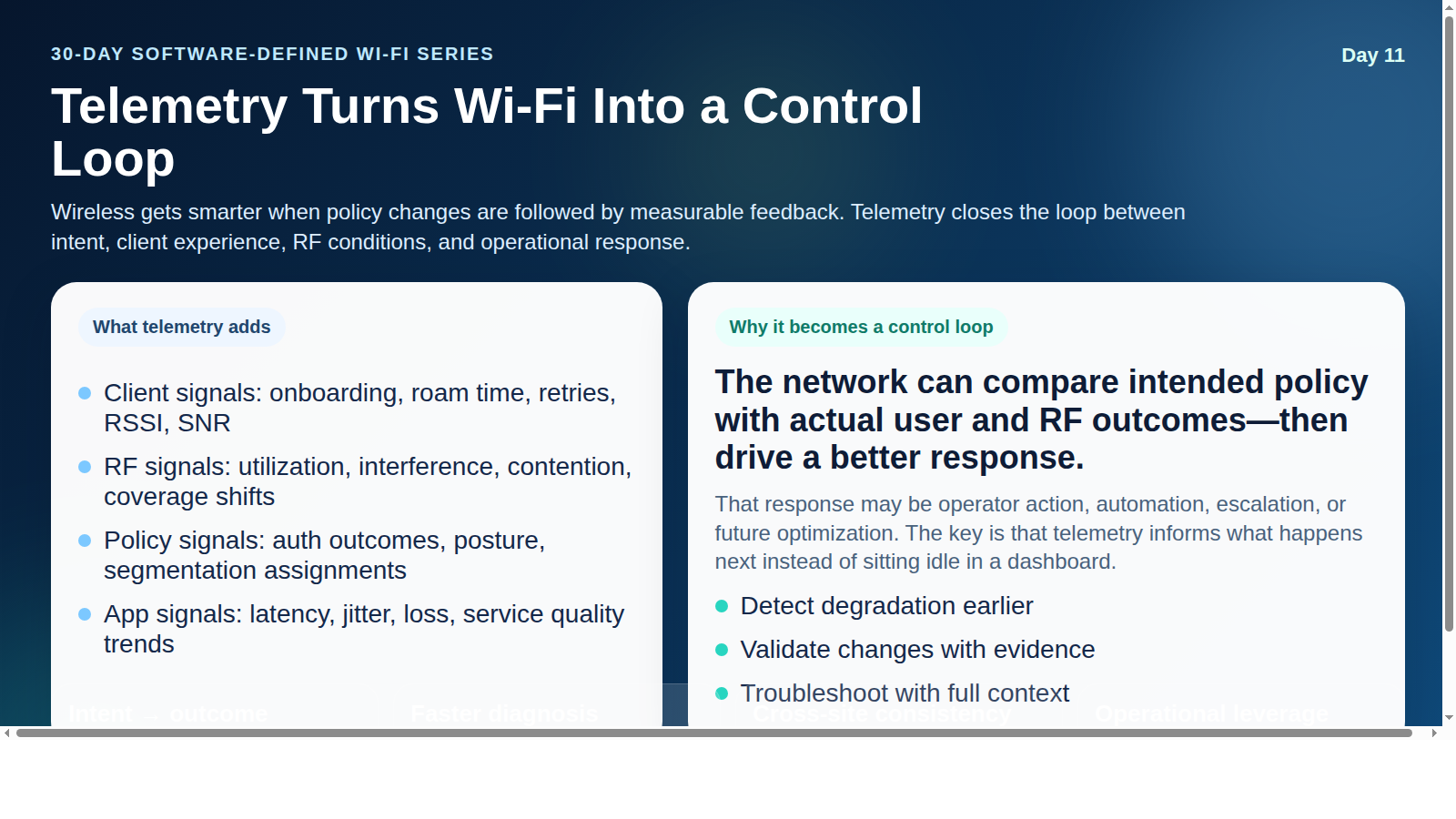
Telemetry Turns Wi‑Fi Into a Control Loop
Software-defined Wi‑Fi is not just about centralized configuration.
Configuration matters, but control only gets interesting when the system can see what happened after a policy is applied.
That is where telemetry changes the game.
Telemetry turns Wi‑Fi into a control loop.
It gives the network a continuous stream of operational feedback so teams are not managing wireless based on assumptions alone.
From one-time configuration to continuous feedback
A lot of wireless operations still behave like this:
- configure SSIDs, RF settings, access rules, and QoS
- deploy changes
- wait for complaints or isolated alerts
- troubleshoot after the experience has already degraded
That is not really control.
It is delayed reaction.
A control loop is different.
In a software-defined model, the network should not only push intent. It should also observe outcomes.
Telemetry is what closes that loop.
It helps answer questions like:
- are clients actually roaming well?
- did a policy change improve or hurt user experience?
- are retries, latency, or authentication failures climbing?
- is one site behaving differently from the rest?
- are RF changes producing the expected result?
Without telemetry, operators are often guessing.
With telemetry, they can manage based on evidence.
What Wi‑Fi telemetry should include
Good telemetry is not just device uptime and CPU graphs.
For wireless operations, useful telemetry spans multiple layers:
- client experience data like onboarding success, roam times, retries, RSSI, SNR, and disconnect patterns
- RF data like channel utilization, interference, contention, and coverage behavior
- infrastructure health like AP, controller, switch, and WAN dependencies
- authentication and policy events like RADIUS outcomes, posture decisions, and segmentation assignments
- application signals like latency, jitter, packet loss, and service-specific quality indicators
- time-series trends that show whether a problem is isolated, repeating, or slowly emerging
This matters because Wi‑Fi problems are rarely caused by one layer alone.
A user says, “Wi‑Fi is bad.”
Telemetry helps separate whether the issue is RF, policy, authentication, backhaul, capacity, or a specific application path.
Why telemetry matters operationally
Telemetry makes wireless teams faster and more precise.
It helps them:
- detect degradation earlier before the help desk fills up
- troubleshoot with context instead of chasing symptoms one device at a time
- compare sites consistently across branches, campuses, or stores
- validate changes by measuring real impact after rollout
- prioritize work better based on client experience instead of loud anecdotes
That is a major shift.
Instead of asking only, “Is the network up?” teams can ask, “Is the network delivering the experience and policy outcome we intended?”
That is a much more useful operating question.
Why this is a control loop, not just observability theater
Plenty of platforms collect data.
That alone does not create a control loop.
The loop forms when telemetry is connected to action.
That action might be:
- an operator adjusting policy or RF settings
- an automation workflow opening a ticket with rich context
- a threshold triggering containment or escalation
- an AI assistant recommending optimization based on actual conditions
- a system automatically correcting a known issue pattern
The important idea is this:
telemetry is not the dashboard
telemetry is the feedback signal that makes better decisions possible
If the data does not influence operations, it is just instrumentation.
If it drives detection, diagnosis, and response, it becomes control.
The strategic takeaway
Telemetry turns Wi‑Fi into a control loop because it connects intent to outcome.
It tells operators whether users are connecting successfully, whether policies are behaving as designed, whether RF conditions are healthy, and whether changes are improving the environment or making it worse.
That is what moves wireless from reactive administration to evidence-driven operation.
In software-defined Wi‑Fi, visibility is not a side feature.
It is the feedback system that makes control real.

Recent Comments