

Identity-Aware Access Makes Wi‑Fi Contextual
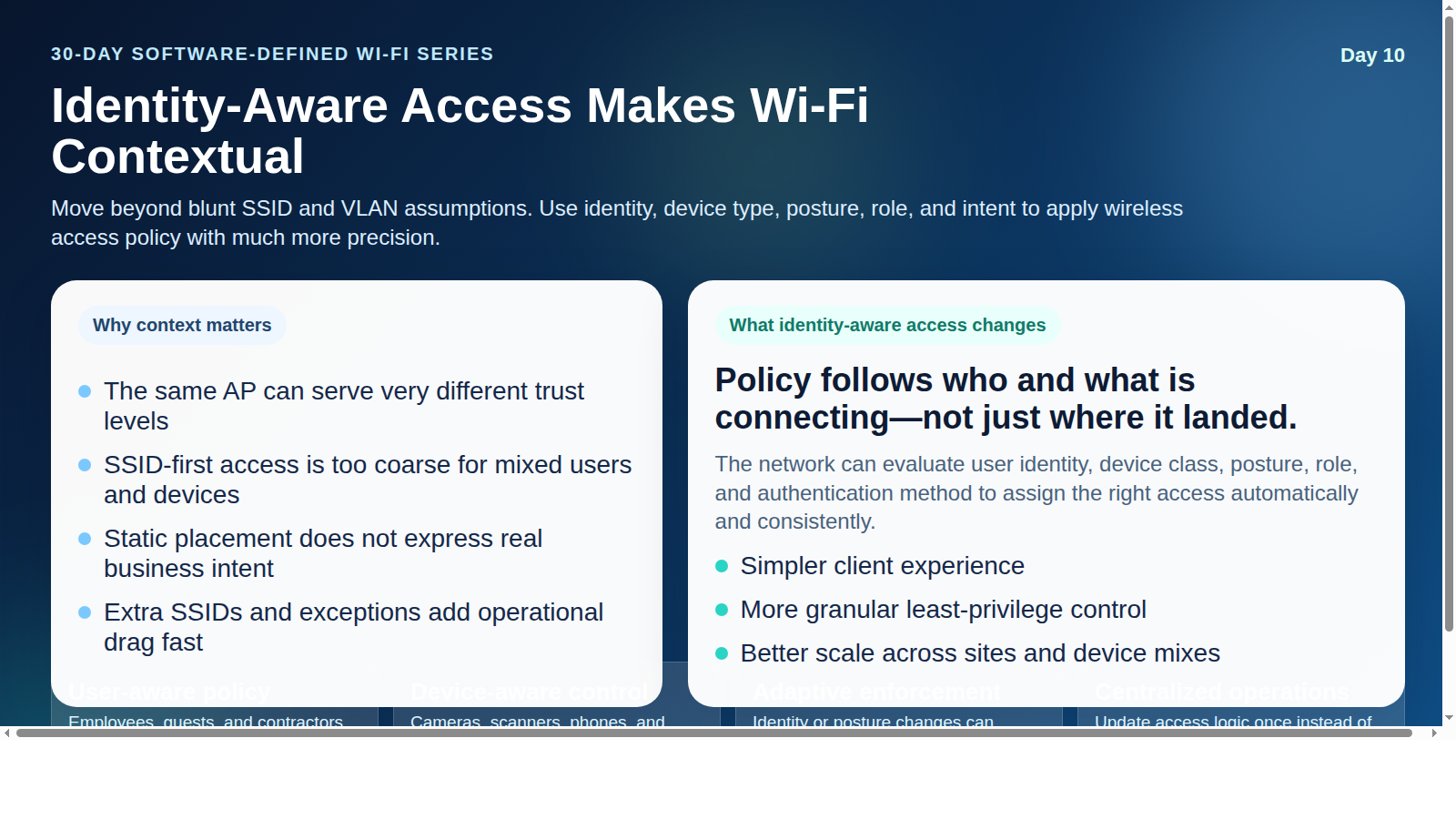
Software-defined Wi‑Fi gets much more valuable when access stops being purely network-centric.
For a long time, wireless access decisions were mostly implied by where a device landed:
- this SSID means employee access
- that SSID means guest access
- this VLAN means IoT
- that subnet means limited trust
That model is familiar, but it is blunt.
It assumes the network can infer intent from placement alone. In modern environments, that is usually not enough.
Identity-aware access is what makes Wi‑Fi contextual.
It lets the network make better decisions based on who is connecting, what kind of device is connecting, and what level of access actually makes sense.
Context matters more than attachment point
Two devices can connect to the same AP and still require completely different policy outcomes.
For example:
- an employee laptop may need internal application access
- a contractor device may need only a few approved services
- a personal phone may need internet-only access
- a badge reader may need access to one control system and nothing else
- a camera may need tightly restricted east-west communication
If all of those decisions depend mainly on SSID selection, the design quickly becomes messy.
Identity-aware access replaces that with a more intelligent model.
Instead of asking only, “Where did this device connect?” the network can ask:
- who is this user?
- what is this device?
- how was it authenticated?
- what role or group does it belong to?
- does its posture meet policy?
- what resources should it actually reach?
That is what makes the access model contextual.
Why this is a better fit for modern Wi‑Fi
Wireless environments are now full of mixed identities and mixed trust levels.
A single branch, campus, clinic, or retail site can include:
- employees
- guests
- contractors
- unmanaged BYOD devices
- scanners and printers
- cameras and sensors
- shared terminals
- third-party systems
Trying to represent all of that with more SSIDs and more static segmentation creates operational drag.
Identity-aware access allows the client experience to stay simpler while policy becomes more precise behind the scenes.
The operational benefit
This is not just a security story.
It is also an operations story.
When access decisions are identity-aware, teams can:
- reduce SSID sprawl without collapsing all policy into one trust zone
- apply policy consistently across sites and device types
- change access centrally without redesigning wireless architecture
- support onboarding and moves faster as people and devices change roles
- audit policy more clearly because intent is expressed directly in rules
That is a big upgrade from managing access through a growing pile of VLAN logic and exceptions.
The security benefit
Identity-aware access also tightens wireless security in a practical way.
It helps enforce least-privilege access by making decisions at a finer level than broad network buckets.
That means:
- fewer overly trusted segments
- less lateral movement opportunity
- better alignment with Zero Trust principles
- more adaptive handling of risky, unknown, or non-compliant devices
If identity or posture changes, policy can change with it.
That is far more useful than assuming every device in the same subnet deserves the same reach.
Context is what makes software-defined control feel real
This is the deeper point.
Software-defined Wi‑Fi is not just about central dashboards or remote configuration.
It is about turning wireless access into a policy system that can interpret context and respond accordingly.
Identity is one of the most important signals in that system.
When the network understands identity, access becomes:
- more granular
- more adaptive
- easier to scale
- easier to govern
- closer to actual business intent
The strategic takeaway
Identity-aware access makes Wi‑Fi contextual because it decouples policy from simplistic network placement.
Instead of treating every connection on the same SSID or VLAN as roughly equivalent, it lets the network enforce access based on identity, device, posture, and role.
That is a much better operating model for modern wireless.
It is simpler for users, smarter for operators, and safer for the business.
Recent Comments