

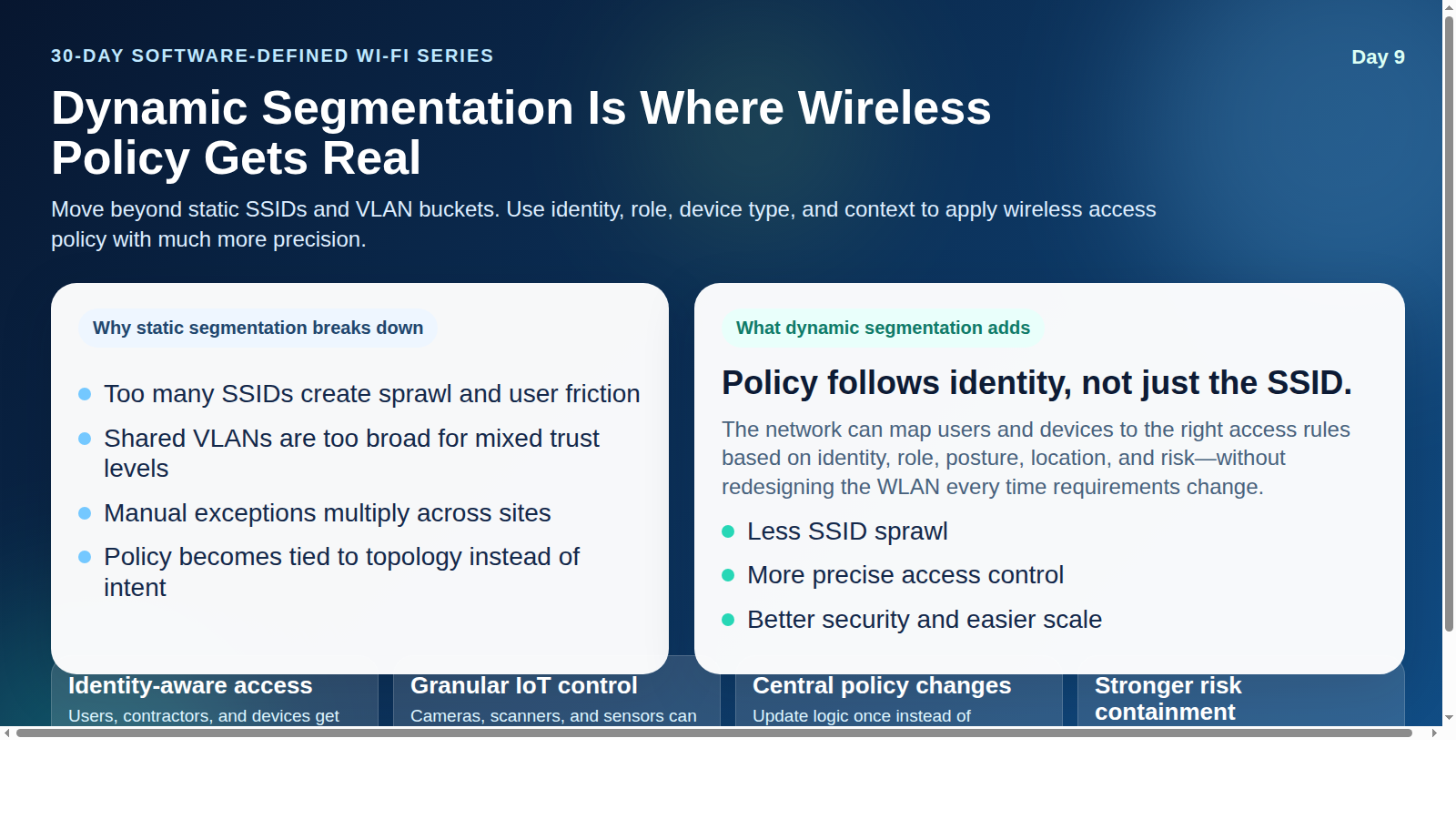
Dynamic Segmentation Is Where Wireless Policy Gets Real
A lot of wireless environments still treat access policy like a plumbing problem.
Put employees on one SSID. Guests on another. IoT on a third. Maybe add a few VLANs, ACLs, and firewall exceptions, then hope the structure holds as more users, devices, and locations pile on.
That model works—until it doesn’t.
Dynamic segmentation is where wireless policy gets real.
It is the shift from static network buckets to policy that follows the user or device wherever it connects.
The limitation of SSID-first design
For years, segmentation in Wi‑Fi was mostly implemented through fixed constructs:
- separate SSIDs
- dedicated VLANs
- manually assigned ACLs
- location-specific exceptions
- device categories handled with one-off rules
That approach creates two problems fast.
First, it becomes operationally messy. Too many SSIDs hurt usability and add design overhead.
Second, it is too coarse. Not every employee needs the same access. Not every IoT device should land in the same trust zone. Not every contractor, scanner, camera, or POS terminal belongs in one shared bucket.
What dynamic segmentation changes
Dynamic segmentation lets the network make access decisions based on context instead of only broadcast structure.
That context can include:
- user identity
- device type or posture
- role or department
- authentication method
- location or site
- time or risk signals
- application or destination policy
Instead of asking, “Which SSID are you on?” the network can ask, “Who are you, what are you, and what should you be allowed to reach?”
That is a much better policy model.
Why this matters operationally
Dynamic segmentation is not just more elegant. It is easier to operate at scale.
It helps teams:
- reduce SSID sprawl without losing control
- apply policy consistently across many sites
- separate users and devices more precisely
- limit lateral movement risk
- support mixed environments like employee, guest, contractor, and IoT access on the same infrastructure
- change policy centrally without redesigning the whole WLAN
This is where software-defined Wi‑Fi starts to show real business value.
You are no longer redesigning the network every time access requirements change.
You are updating policy logic.
A better fit for modern environments
Modern wireless networks are full of overlapping identities and trust levels.
A single site might include:
- full-time staff
- contractors
- guests
- point-of-sale systems
- cameras
- printers
- sensors
- handheld scanners
- personal devices
Trying to represent all of that with static SSIDs and VLANs creates unnecessary complexity.
Dynamic segmentation lets teams keep the client experience simpler while making the policy model smarter.
The security upside
This is also where wireless segmentation starts aligning more closely with Zero Trust thinking.
Access becomes:
- more granular
- more adaptive
- easier to audit
- less dependent on broad trust zones
If a device should only reach a narrow set of services, the network can enforce that.
If a contractor should have limited internal access at one site but none at another, the policy can reflect that.
If an IoT device fails posture or identity checks, it can be isolated automatically.
That is much stronger than treating the entire VLAN as equally trusted.
The strategic takeaway
Dynamic segmentation is not just a security feature.
It is a better operating model for wireless policy.
It reduces dependence on static network design, improves consistency, and lets access decisions follow identity and intent instead of fixed topology.
That is where wireless policy stops being a rough approximation and starts behaving like software-defined control.
Recent Comments