

AI-Assisted RF Optimization Needs Good Inputs, Not Magic
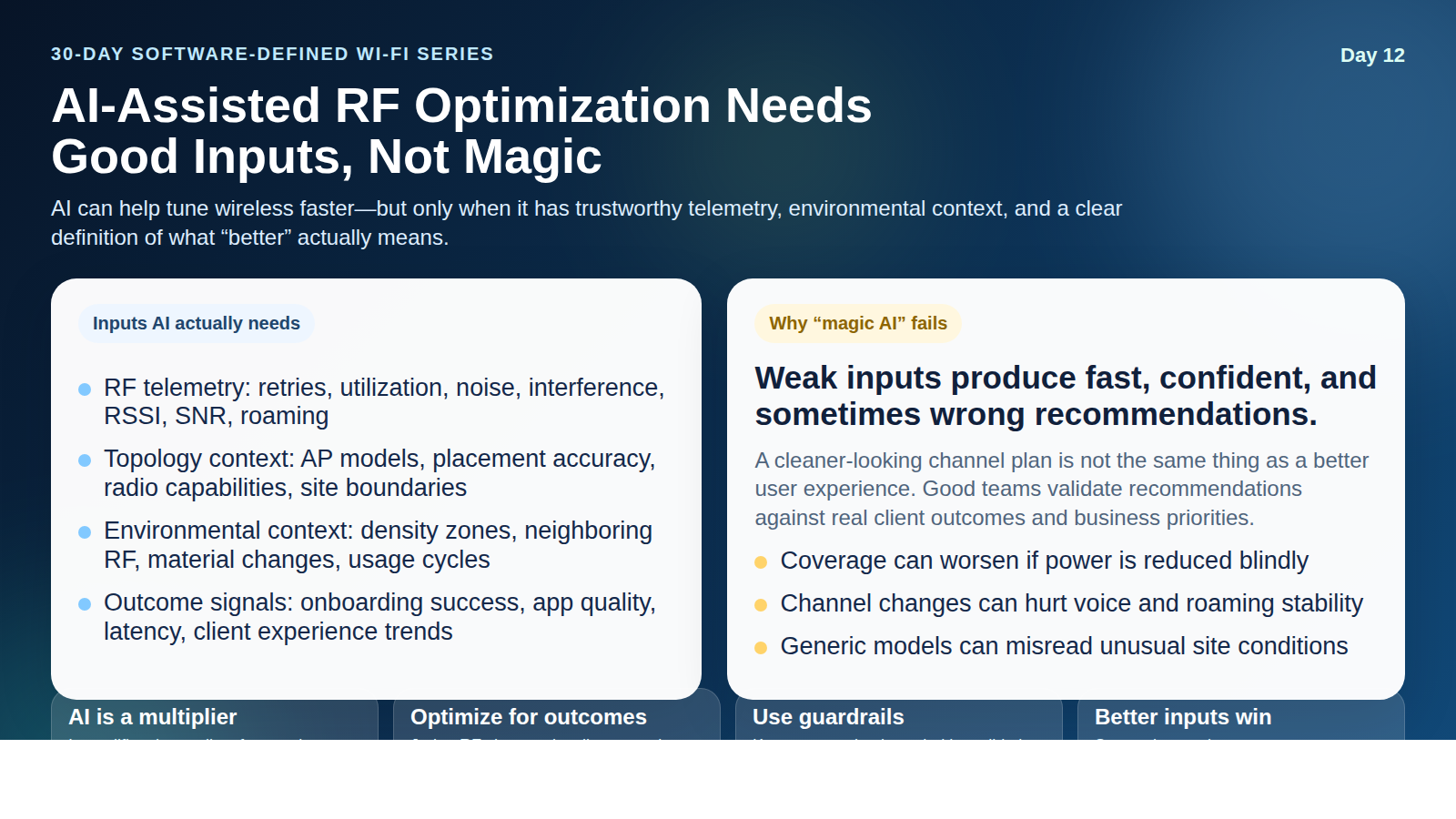
Summary: AI can help optimize Wi‑Fi RF decisions, but only when the platform has trustworthy telemetry, accurate topology, and clear operational objectives.
AI is showing up in Wi‑Fi platforms everywhere.
That is not automatically a bad thing.
Used well, AI can help operators spot RF patterns faster, recommend better channel or power changes, and surface problems that would be hard to see manually across large environments.
But there is a problem with how this gets marketed.
Too often, AI is presented like a magic layer that somehow fixes wireless complexity by itself.
It doesn’t.
AI-assisted RF optimization only works when the inputs are good.
If the telemetry is incomplete, the floor plan is wrong, the AP placement data is stale, the client mix is misunderstood, or the optimization target is vague, the output will be unreliable no matter how impressive the interface looks.
What AI can actually help with
There is real value here when the foundation is solid.
AI-assisted RF systems can help with things like:
- identifying channel contention patterns across many APs
- spotting abnormal retry, roam, or interference behavior
- recommending transmit power adjustments
- prioritizing likely root causes faster than manual review
- comparing similar sites to detect outliers
- surfacing optimization opportunities before users complain
That is useful.
But notice what all of those depend on.
They depend on data.
Not vague “AI intelligence.” Real operational inputs.
The inputs that matter most
For RF optimization, the quality of the outcome is tightly linked to the quality of the telemetry and context behind it.
That usually includes:
- accurate RF telemetry such as channel utilization, retries, noise, interference, RSSI, SNR, roam behavior, and client distribution
- reliable topology and inventory context including AP models, radio capabilities, antenna assumptions, site boundaries, and placement accuracy
- environmental awareness like dense client zones, physical changes, neighboring interference, and time-of-day usage patterns
- client experience signals so the system is not optimizing RF in a way that looks tidy on paper but hurts actual onboarding, roaming, or application quality
- clear policy and business objectives such as whether the priority is coverage stability, capacity, voice performance, high-density events, or power efficiency
Without that context, optimization can drift toward the wrong answer.
Why “better-looking RF” is not enough
One of the biggest mistakes in wireless operations is treating RF optimization like a spreadsheet exercise.
A cleaner channel map is not automatically a better user experience.
For example:
- reducing transmit power may lower contention but create edge-coverage problems
- aggressive channel changes may look efficient but disrupt latency-sensitive clients
- an optimization that improves averages may still make one critical floor much worse
- a model trained on generic environments may misread a site with unusual materials, device mix, or usage cycles
That is why good optimization needs both RF signals and outcome signals.
The point is not to create prettier RF statistics. The point is to improve real client experience.
What strong teams do differently
The best wireless teams do not hand control to AI blindly.
They treat AI as a decision-support layer inside a broader operating model.
That means they:
- validate that telemetry quality is high enough to trust recommendations
- define what “better” means before tuning begins
- test changes in context instead of assuming every recommendation is safe
- compare recommendations against client and application outcomes
- use automation with guardrails, not unchecked autonomy
That is the mature posture.
AI should reduce manual effort and improve decision quality. It should not become an excuse to stop thinking about RF fundamentals.
The strategic takeaway
AI-assisted RF optimization is promising because wireless environments are too dynamic and too distributed for purely manual tuning to scale well.
But AI is not magic.
It is a multiplier.
If the network has strong telemetry, accurate context, and clearly defined goals, AI can help operators optimize faster and more confidently.
If those inputs are weak, AI can just produce bad recommendations at software speed.
In software-defined Wi‑Fi, the lesson is simple:
better intelligence starts with better inputs
That is what makes AI operationally useful instead of just marketable.
Recent Comments