

Templates and Policy Profiles Make Wi‑Fi Repeatable
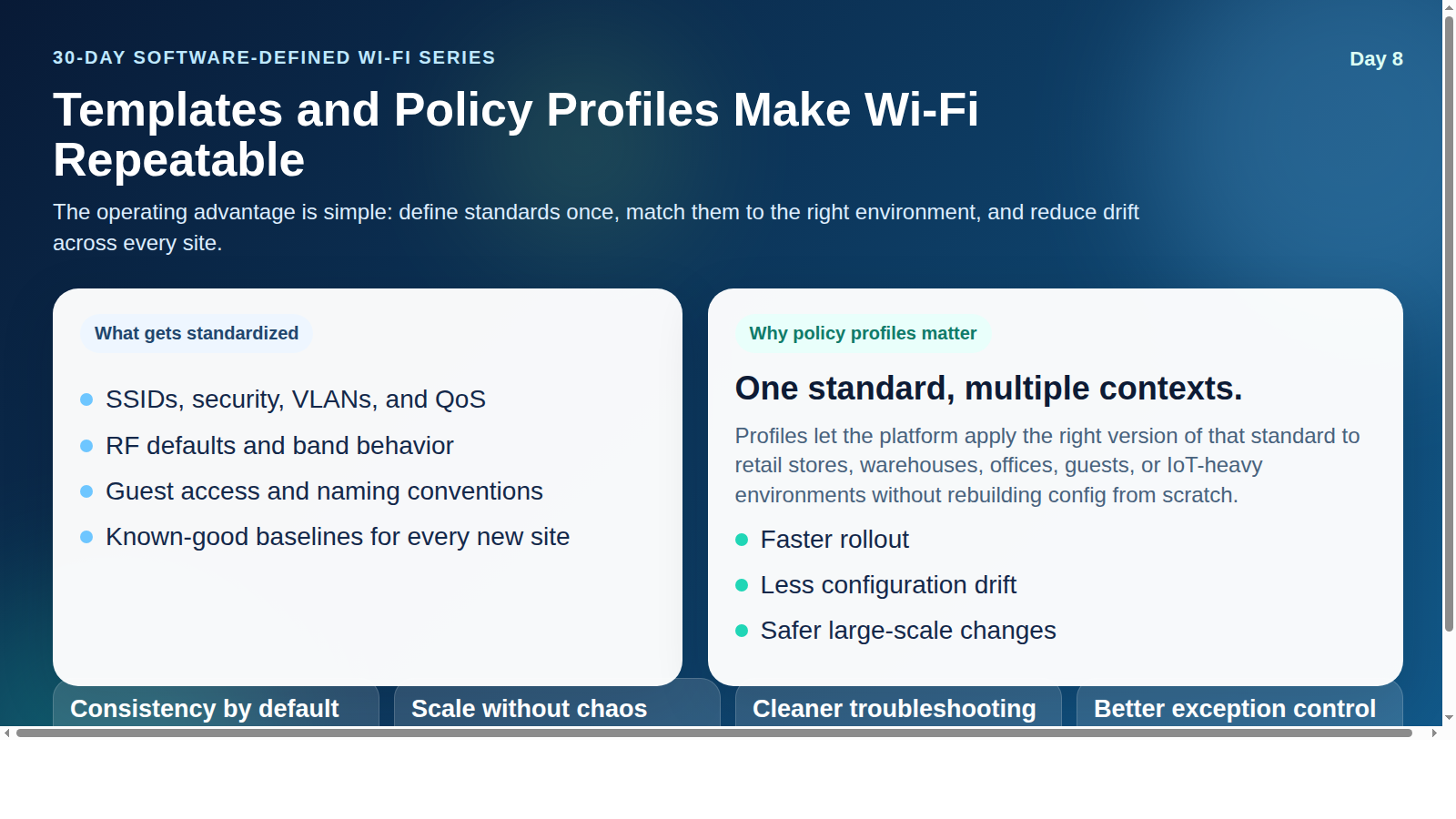
One of the biggest differences between legacy Wi‑Fi and software-defined Wi‑Fi is not just centralization.
It’s repeatability.
A network team should not have to reinvent the same SSID, security, QoS, VLAN, and access rules every time a new site comes online. If the environment depends on manual recreation, it might be centralized, but it still is not operating like software.
Templates and policy profiles are what make Wi‑Fi repeatable.
They turn preferred designs into reusable operational building blocks.
What templates actually do
In practical terms, templates let teams standardize how Wi‑Fi should be deployed across sites, device groups, or use cases.
A template can define things like:
- SSIDs and broadcast behavior
- security settings and authentication methods
- VLAN mappings
- QoS behavior
- RF settings and band preferences
- guest access defaults
- site-wide naming conventions
Instead of rebuilding those settings over and over, teams create a known-good model and reuse it.
Where policy profiles matter
Templates alone are helpful, but policy profiles are what make them adaptable.
A policy profile lets the platform apply the right rules to the right environment without starting from scratch each time.
For example:
- a retail branch can inherit a standard store profile
- a warehouse can inherit a coverage-first RF profile
- a corporate office can inherit stronger segmentation and identity rules
- a guest network can inherit internet-only access and traffic limits
That is the real win: not one giant generic configuration, but repeatable patterns matched to real operating contexts.
Why repeatability matters more than convenience
This is not just about saving time.
Repeatability improves the entire operating model:
- Consistency: sites behave the same way by default
- Faster deployment: new locations inherit standards immediately
- Less drift: fewer one-off changes pile up over time
- Safer changes: updates can be tested once, then rolled out broadly
- Cleaner troubleshooting: teams know what a site is supposed to look like
When the network is built from repeatable templates, operations become more predictable.
The hidden benefit: better exceptions
Good templates do not eliminate exceptions.
They make exceptions easier to manage.
When the baseline is clear, teams can spot and justify deviations instead of discovering them accidentally months later.
That matters for:
- temporary event networks
- executive or IoT carve-outs
- high-density venues
- compliance-sensitive areas
- phased migrations
Without a standard baseline, everything starts to look like a special case.
Repeatability is what makes scale survivable
This is especially important in distributed environments.
If you operate 5 sites, manual tuning is annoying.
If you operate 500, manual tuning becomes a structural weakness.
Templates and policy profiles let small teams support large estates because they reduce Wi‑Fi operations to governed reuse instead of endless reconfiguration.
The strategic takeaway
Software-defined Wi‑Fi is not just about putting settings in the cloud.
It is about making network intent reusable.
Templates define the standard.
Policy profiles apply the standard in the right context.
Together, they make Wi‑Fi consistent, scalable, and much easier to operate.
That is how wireless moves from custom craftwork to repeatable system design.
Recent Comments