

SDNWiFi vs Traditional WiFi: What Actually Changes?
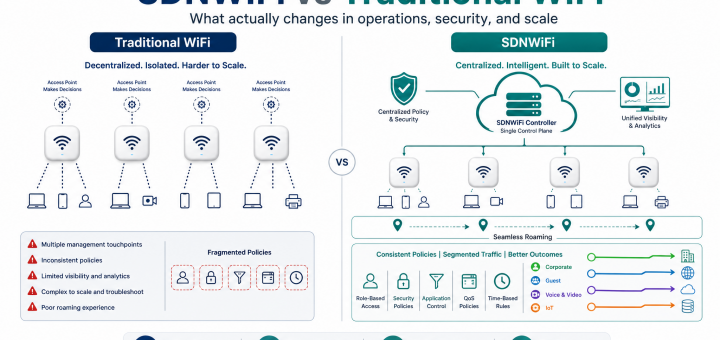
SDNWiFi vs Traditional WiFi: What Actually Changes?
This is day 2 of our 30-day publishing sequence focused on practical Software Defined Networking WiFi strategy for modern networks.
Why this comparison matters
Many teams hear the term software-defined WiFi and assume it is just a nicer dashboard layered on top of the same old wireless model. In reality, the operational difference is much bigger. Traditional WiFi usually depends on access points making more local decisions, while SDNWiFi pushes policy, visibility, and orchestration into a centralized software layer.
That shift changes how networks are deployed, secured, scaled, and troubleshot. If day 1 explained what SDNWiFi is, day 2 is about what actually changes once you move from a box-by-box mindset to a centrally managed wireless system.
Traditional WiFi: where friction usually starts
In a traditional setup, each access point or controller cluster may be configured with more manual effort. Even when the network works, operations often become slower over time because teams have to check multiple places for settings, firmware, RF behavior, VLAN mapping, and user issues.
- Configuration drift: settings slowly become inconsistent across sites or floors
- Slower troubleshooting: root cause analysis requires jumping between devices and logs
- Uneven user experience: roaming, channel planning, and QoS may behave differently across the environment
- Security gaps: segmentation and policy enforcement are harder to keep consistent
- Scaling pain: adding more locations often adds operational overhead linearly
SDNWiFi: what improves
With SDNWiFi, the control layer becomes the center of gravity. Policies, SSIDs, segmentation rules, analytics, and automation are managed from software, then applied across the wireless environment in a coordinated way.
- Centralized policy: one place to define wireless behavior and security intent
- Faster deployment: new APs, sites, and changes can be rolled out with less manual effort
- Better visibility: telemetry, client behavior, and performance trends are easier to spot
- Smarter optimization: software can assist with roaming, RF tuning, and health monitoring
- More reliable growth: expansion becomes structured instead of improvised
What changes for the IT team
The biggest difference is not just technical, it is operational. In traditional WiFi, teams spend more time touching individual components. In SDNWiFi, teams spend more time defining standards, validating outcomes, and automating repeatable decisions.
That means less firefighting around isolated devices and more control over the whole service. It also makes it easier to align wireless design with business goals like guest access, IoT segmentation, branch consistency, and security policy enforcement.
A simple rule of thumb
If your wireless network is small and static, traditional management may feel acceptable for a while. But once you have multiple APs, multiple VLANs, multiple locations, or high expectations for reliability, SDNWiFi starts paying back quickly through consistency and lower operational drag.
Takeaway
Traditional WiFi focuses on managing devices. SDNWiFi focuses on managing intent. That is the real shift: less scattered control, more software-driven coordination, and a better foundation for secure, scalable wireless operations.
Keywords: SDNWiFi, traditional WiFi, centralized wireless control, enterprise WiFi, network operations
Recent Comments