
Zero-Touch Provisioning Is the Moment Wi‑Fi Became Software-Defined
For years, Wi‑Fi deployments were slowed down by one stubborn reality: every new access point needed hands-on setup.
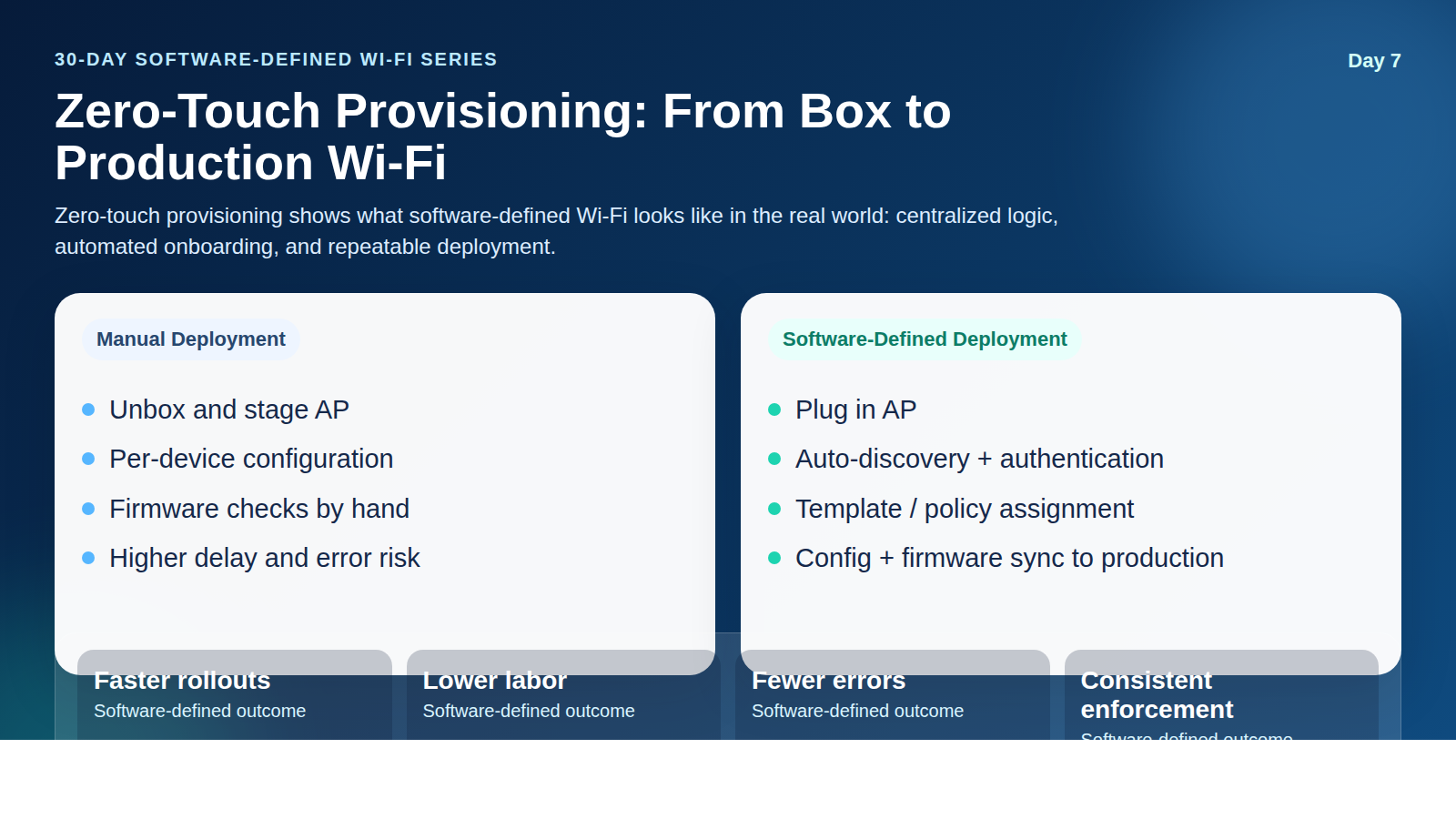
Someone had to unbox it, stage it, assign settings, validate firmware, map it to the right site, and hope nothing got missed. That model doesn’t scale when you’re rolling out dozens, hundreds, or thousands of locations.
Zero-touch provisioning changes that.
And more importantly, it’s one of the clearest signs that Wi‑Fi has become truly software-defined.
What zero-touch provisioning actually means
In a software-defined Wi‑Fi architecture, an access point should be able to:
- power on
- discover its controller or cloud platform
- authenticate itself
- download the correct configuration
- inherit policies based on site, role, or device profile
- come online with little or no manual intervention
That’s zero-touch provisioning in practice.
The AP becomes less like a box that needs custom setup and more like an endpoint that joins an automated system.
Why this matters
Zero-touch provisioning is not just a deployment convenience. It changes the operating model.
Instead of configuring devices one at a time, IT teams define intent once and apply it everywhere. That means:
- faster rollouts across distributed sites
- lower labor costs for installs and replacements
- fewer configuration mistakes
- more consistent security and policy enforcement
- simpler lifecycle management
When a failed AP can be replaced by plugging in a new unit and letting software do the rest, the network becomes dramatically easier to run.
The real shift: from device configuration to policy orchestration
Legacy Wi‑Fi was device-centric.
Software-defined Wi‑Fi is policy-centric.
That’s the deeper story.
With zero-touch provisioning, the goal is no longer to lovingly configure each access point. The goal is to define:
- what this site should look like
- what SSIDs should exist
- what security posture should apply
- what segmentation rules belong here
- what performance profile is expected
Then the platform handles enforcement automatically.
Where organizations see the biggest payoff
Zero-touch provisioning is especially valuable for:
- retail chains
- restaurants
- branch offices
- schools
- healthcare clinics
- hospitality groups
- managed service providers
Any environment with many locations and lean IT staffing benefits immediately.
If you need a technician onsite for every configuration change, scale gets expensive fast. If you can ship hardware to a site and let it self-provision, growth becomes much easier.
But zero-touch is only as good as the system behind it
You still need:
- secure onboarding
- accurate inventory and device identity
- clean site templates
- role-based policy design
- firmware governance
- reliable controller or cloud connectivity
Without that foundation, “zero-touch” can turn into “zero-visibility chaos.”
The strategic takeaway
Zero-touch provisioning is one of those features that sounds operational, but it’s actually strategic.
It reduces deployment friction.
It improves consistency.
It shortens time-to-value.
And it lets network teams operate with software logic instead of manual repetition.
In other words, zero-touch provisioning isn’t just a feature.
It’s a proof point that the network is finally behaving like software.
Recent Comments