

Centralized Policy Is Where Wi‑Fi Stops Being Box-by-Box
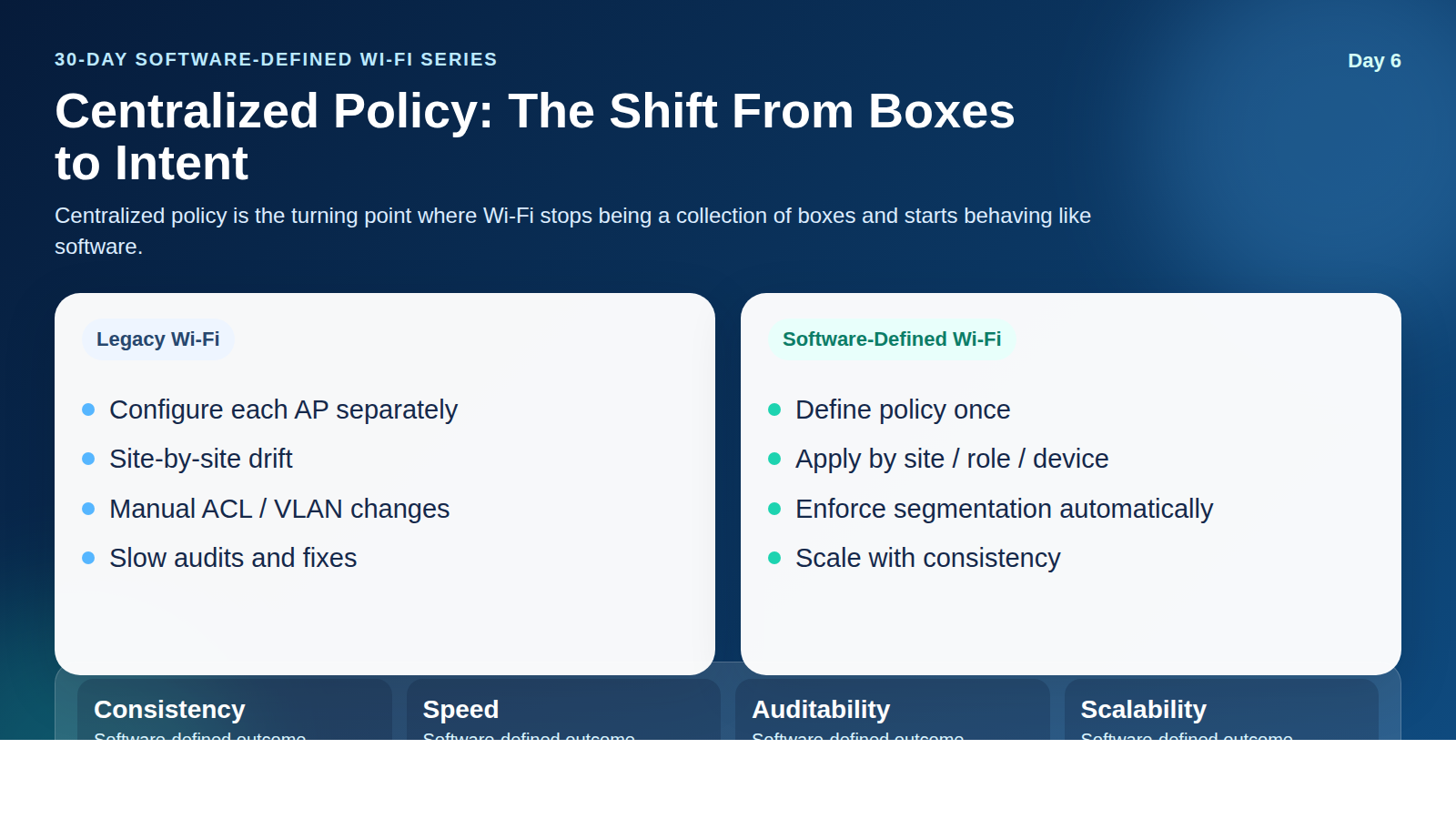
For a long time, Wi‑Fi management was basically a scaling problem disguised as a networking problem.
Every access point, SSID, VLAN, ACL, and exception had to be configured, checked, and maintained across a growing pile of hardware. Even when controllers entered the picture, many environments still operated with a device-first mindset.
Centralized policy changed the game.
This is the point where Wi‑Fi starts to feel truly software-defined: not because everything lives in one dashboard, but because policy becomes the source of truth.
The old model: configure boxes
In the legacy model, teams spent time answering questions like:
- Did this AP get the right SSID set?
- Does this branch have the same guest policy as every other branch?
- Which locations are missing the latest ACL update?
- Did the replacement hardware inherit the right settings?
That approach creates drift fast.
The more locations you add, the more likely the network stops behaving consistently.
The new model: define intent once
In software-defined Wi‑Fi, the better question is:
What policy should this site, user group, or device class inherit by default?
Instead of hand-tuning individual boxes, teams define rules centrally for:
- SSID behavior
- access control
- segmentation
- QoS priorities
- guest policies
- device roles
- site standards
Then the system pushes and enforces those decisions everywhere they belong.
Why centralized policy matters so much
This shift creates four immediate advantages:
- Consistency: every site follows the same logic
- Speed: changes happen once, not dozens of times
- Auditability: teams can see what policy is supposed to apply
- Scalability: growth no longer multiplies manual effort linearly
This is what separates a managed Wi‑Fi estate from a programmable one.
Policy is what makes automation trustworthy
Automation without policy is just fast chaos.
If the platform cannot clearly map rules to sites, users, devices, and exceptions, then every automated workflow becomes risky. But when policy is structured well, automation becomes reliable because the system knows what “correct” looks like.
That matters for:
- site rollouts
- hardware replacements
- security updates
- guest access changes
- troubleshooting
- compliance checks
Centralized policy is also an organizational shift
This isn’t only technical.
Centralized policy changes how network teams operate.
It moves the team away from repetitive configuration work and toward:
- standards design
- exception handling
- lifecycle governance
- performance optimization
- security alignment
That is a healthier operating model, especially for lean IT teams supporting many locations.
The strategic takeaway
A dashboard alone does not make Wi‑Fi software-defined.
Centralized policy does.
The real milestone is when the network no longer depends on humans remembering which boxes need which settings. Instead, the environment follows centrally managed logic and stays aligned as the business grows.
That’s where Wi‑Fi stops being a collection of devices and starts acting like a software system.
Recent Comments